
How Is Mattress Foam Manufactured? Inside the Foam Manufacturing Process
Mattress foam is manufactured through a controlled process in which carefully selected raw materials react to create a cellular foam structure. The process involves formulation, mixing, foaming, expansion, curing, cutting, and quality control. Manufacturers can adjust characteristics such as density, hardness, and resilience depending on how the foam will eventually be used.Most people have slept on a foam mattress.Very few have seen how the foam inside that mattress is actually made.By the time a customer sees a finished mattress, the foam has already passed through several stages of manufacturing. Raw materials have been selected and formulated. Chemical reactions have taken place. The foam has expanded, cured, been cut, processed, and prepared for its intended application.Understanding this process reveals something important about mattresses:The quality of a finished mattress begins long before its outer fabric is stitched.For Safari Mattresses, foam manufacturing is particularly relevant because the brand is part of the Shakti Foams family and is backed by more than 25 years of experience in foam and comfort-product manufacturing.So, how does a liquid formulation eventually become the foam used inside a mattress?Here is a closer look inside the process.
What Is Mattress Foam Made From?
Many types of mattress foam belong to the polyurethane family.
Polyurethane foam is produced through a controlled chemical reaction involving specific raw materials and additives.
The exact formulation depends on the type of foam being manufactured and the characteristics required from the finished product.
Manufacturers may develop foam for different requirements relating to:
- Density
- Hardness
- Resilience
- Comfort
- Support
- Cell structure
- Intended application
This is why the term “foam” alone tells buyers very little about the material inside a mattress.
Different formulations and manufacturing processes can create foams with very different performance characteristics.
If you want to understand one of the most widely used foam categories first, our guide to what PU foam is and why it is used in mattresses provides a detailed introduction.
Step 1: Developing the Foam Formulation
The manufacturing process begins with formulation.
Before foam production starts, manufacturers need to determine what characteristics the finished material should provide.
Is the foam intended for cushioning?
Support?
Responsiveness?
A mattress application?
Furniture?
Another comfort product?
Different applications can require different material characteristics.
The formulation therefore plays an important role in determining how the finished foam will behave.
Manufacturers must understand the intended application before deciding what kind of foam needs to be produced.
This is one reason foam manufacturing expertise matters.
The objective is not simply to produce foam.
It is to produce foam with characteristics suited to a particular purpose.
Step 2: Measuring and Mixing the Raw Materials
Once the formulation has been established, the required components must be accurately measured and mixed.
Precision is important.
Changes in formulation, ratios, mixing, and production conditions can influence the characteristics of the finished foam.
During manufacturing, the materials are brought together under controlled conditions to begin the chemical reaction that creates polyurethane foam.
Modern foam manufacturing technology can help manufacturers manage this process with greater control and consistency.
According to the Safari Mattresses company story, the manufacturing journey behind the brand has evolved from traditional box-foaming machinery to the use of a Hennecke High-Pressure Foaming Machine from Germany.
This progression in manufacturing technology forms an important part of the Shakti Foams story.
Step 3: The Foaming Reaction Begins
Once the components are mixed, the foaming reaction begins.
The material starts to expand and develop the cellular structure associated with foam.
This is one of the most important stages of the manufacturing process.
The chemical formulation and production conditions influence characteristics of the finished foam.
Depending on the intended application, manufacturers may need to consider factors such as:
- Foam structure
- Density
- Hardness
- Resilience
- Consistency
What begins as carefully measured raw materials gradually develops into a much larger foam structure.
Step 4: The Foam Expands
During the foaming process, the reacting material expands.
This expansion creates the cellular structure that gives foam many of its familiar characteristics.
But foam expansion is not simply about creating volume.
The manufacturer needs to produce material that meets the intended specifications.
For mattress applications, this matters because foam can eventually be required to perform different functions within the finished product.
Some foam may be used for comfort.
Other materials may contribute to transition or support.
Different mattress designs can therefore require different foam characteristics.
This is why understanding how a quality mattress is built layer by layer is useful when looking at the relationship between foam manufacturing and finished mattresses.
Step 5: The Foam Is Allowed to Cure
Once the foam has expanded and formed, it needs time to stabilise and cure.
Curing is an important part of the manufacturing process.
The foam cannot simply be produced and immediately placed inside a finished mattress.
It must first reach the appropriate condition for further processing.
The specific production and curing process can vary depending on the foam type, manufacturing technology, and intended application.
Once the foam is ready, it can move to the next stages of processing.
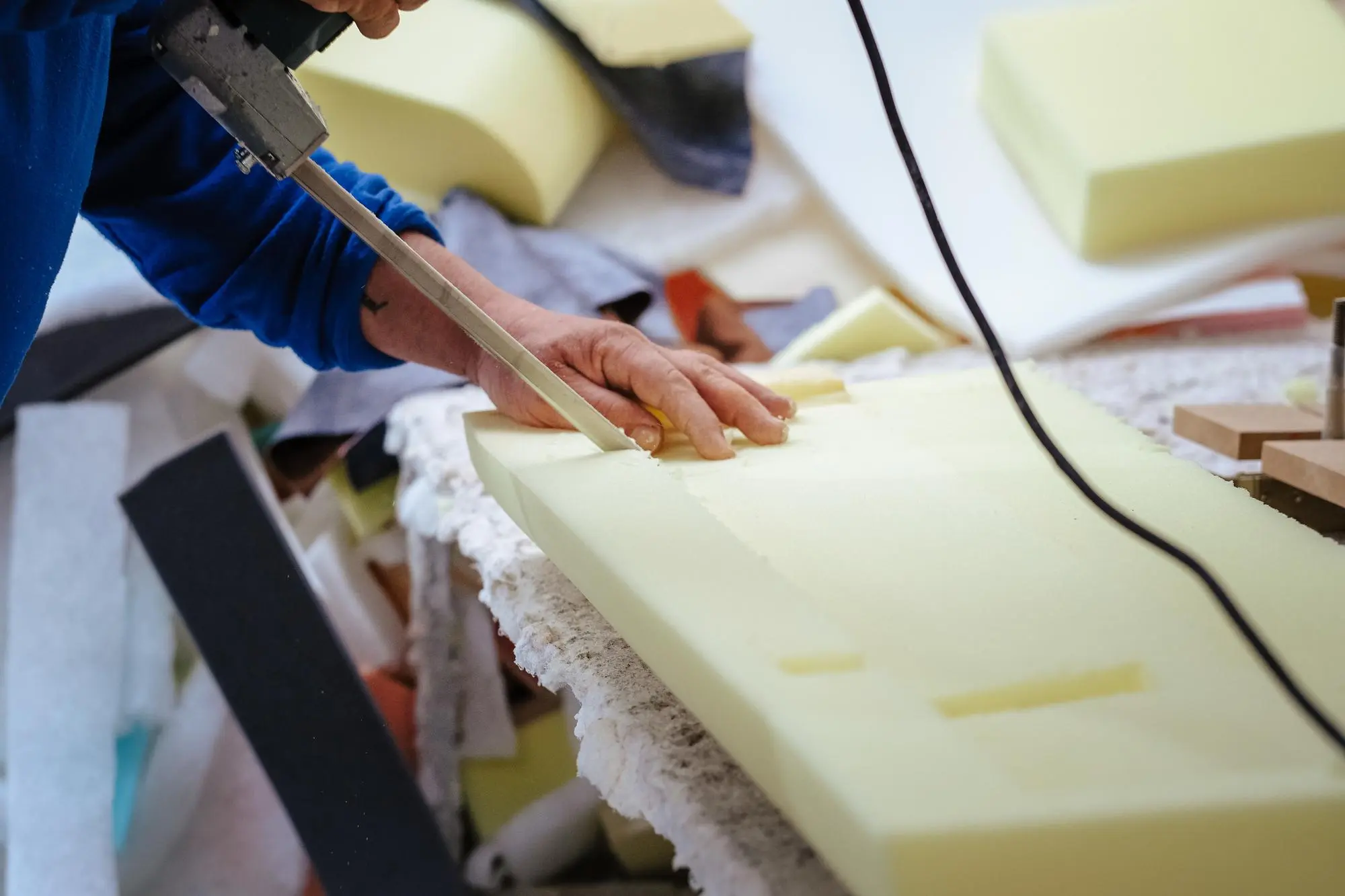
Step 6: Foam Blocks Are Cut and Processed
Large foam blocks are not the final product.
After manufacturing and curing, foam can be cut and processed according to its intended application.
Depending on the product requirements, manufacturers may prepare foam in different:
- Dimensions
- Thicknesses
- Shapes
- Profiles
For mattress manufacturing, foam may need to be cut into specific layers that form part of the final construction.
The thickness and characteristics of each layer can influence how the complete mattress performs.
This is why two mattresses of identical overall thickness can provide completely different sleeping experiences.
As we explain in our guide to whether a thicker mattress actually means better comfort, what is inside the mattress matters just as much as its total height.
Step 7: Manufacturers Evaluate Foam Characteristics
Producing foam is only part of the process.
Manufacturers also need to evaluate whether the finished material meets the required characteristics for its intended application.
Depending on the foam and manufacturing process, important characteristics may include:
- Density
- Hardness
- Resilience
- Dimensions
- Appearance
- Consistency
Each characteristic tells the manufacturer something different.
Density does not mean firmness.
Firmness does not mean resilience.
And no single specification can tell buyers everything about the quality of a mattress.
This is why our guide on why mattress density matters more than most buyers realise encourages buyers to understand specifications within the context of complete mattress construction.
Why Is Manufacturing Consistency Important?
Imagine buying the same mattress model as someone else but receiving a product that performs completely differently.
That is why consistency matters in manufacturing.
A product should meet the characteristics and specifications it was designed to provide.
Maintaining consistency can depend on several factors, including:
- Raw material control
- Formulation
- Production technology
- Process management
- Quality evaluation
For established foam manufacturers, manufacturing is not simply about producing large quantities of material.
It is also about maintaining the intended product characteristics across production.
Traditional Box Foaming vs Modern Foam Manufacturing Technology
Foam manufacturing technology has evolved significantly over time.
Earlier production methods included box foaming, where foam was produced in individual batches.
Modern manufacturing systems can provide greater control over different stages of the production process.
The history behind Safari Mattresses reflects this technological progression.
According to Safari’s official company history, Shakti Foams began its journey with box-foaming machinery and later adopted a Hennecke High-Pressure Foaming Machine from Germany.
High-pressure foaming technology represents a significant development in the manufacturing journey because it allows manufacturers to work with greater control over the mixing and production process.
For Safari, this manufacturing evolution forms part of a wider story connecting foam production expertise with finished mattress development.
You can read more about the relationship between Safari Mattresses and Shakti Foams.
How Does Manufactured Foam Become a Mattress?
Once foam has been manufactured, cured, evaluated, and processed, selected materials can be used as components within mattress construction.
A mattress may contain:
- Comfort layers
- Transition layers
- Support layers
- Base layers
- Quilting materials
- Outer fabrics
Different materials are selected for different functions.
This is where foam manufacturing and mattress manufacturing come together.
The objective is no longer simply to manufacture a foam with certain characteristics.
The next challenge is to understand how different materials can be combined to create the intended mattress.
Why Does Foam Manufacturing Knowledge Matter for Safari Mattresses?
Many buyers only interact with the final mattress.
They see the product name, fabric, thickness, price, and features.
Behind that finished product are decisions about:
- Materials
- Foam characteristics
- Layer construction
- Comfort
- Support
- Product consistency
Safari Mattresses is part of the Shakti Foams family, connecting the consumer mattress brand with more than 25 years of foam and comfort-product manufacturing experience.
The Shakti Foams product portfolio includes PU foam, HR foam, memory foam, peeling foam, fire-retardant foam, mattresses, pillows, sofa cushions, and other comfort products.
This background provides valuable context for understanding the manufacturing knowledge behind Safari Mattresses.
Does Better Foam Automatically Mean a Better Mattress?
Not necessarily.
This is an important distinction.
Quality materials are important, but a mattress is a complete product.
Its performance depends on how different components work together.
Manufacturers need to consider:
- Material selection
- Layer thickness
- Foam characteristics
- Mattress construction
- Intended comfort
- Intended support
A good material used incorrectly does not automatically create a good mattress.
This is why understanding what makes a high-quality mattress from a manufacturer's perspective is valuable for buyers who want to look beyond surface-level claims.
From Foam Manufacturing to Safari Mattresses
The complete journey from raw materials to a finished mattress involves multiple stages.
It begins with understanding what type of material needs to be manufactured.
Then comes formulation.
Mixing.
Foaming.
Expansion.
Curing.
Processing.
Evaluation.
Mattress construction.
And finally, the finished product.
Different products may use different materials and construction approaches according to their intended comfort and support characteristics.
For example, the Safari Ortho Latex Mattress and the Safari Ortho Divine Mattress are developed around different material and construction approaches.
You can also explore the complete Safari Mattress Collection to understand the different sleep solutions available.
Why Should Mattress Buyers Care About Foam Manufacturing?
Most buyers do not need to understand every chemical reaction involved in producing foam.
But understanding the manufacturing process can change the questions they ask.
Instead of evaluating a mattress only by:
- Price
- Thickness
- Appearance
- Marketing claims
buyers can begin asking:
- Who manufactures the mattress?
- What materials are used inside?
- Does the manufacturer understand foam production?
- How are different layers selected?
- What quality characteristics matter?
- How does the complete mattress construction work?
These questions can lead to a much more informed purchase.
Final Thoughts
The foam inside a mattress begins its journey long before the finished product reaches your bedroom.
From formulation and controlled chemical reactions to expansion, curing, processing, evaluation, and mattress construction, every stage contributes to the development of the final product.
For Safari Mattresses, this manufacturing process is closely connected to the expertise of Shakti Foams and a journey spanning more than 25 years in foam and comfort-product manufacturing.
Understanding how mattress foam is made helps buyers recognise an important fact:
A mattress is not defined only by what you can see from the outside.
The materials, processes, technology, manufacturing knowledge, and construction decisions behind it matter too.
FAQs
How is mattress foam manufactured?
Mattress foam is manufactured through a controlled process involving raw material formulation, measuring and mixing, chemical reaction, foam expansion, curing, cutting, processing, and quality evaluation.
What is mattress foam made from?
Many mattress foams belong to the polyurethane family and are created through controlled chemical reactions involving specific raw materials and additives. The exact formulation depends on the type and intended application of the foam.
Why does foam need to cure after manufacturing?
Curing allows newly produced foam to stabilise before it is processed, cut, evaluated, or used in finished products.
What happens to foam after it is manufactured?
After production and curing, foam can be cut, processed, and evaluated according to its intended application. Selected foam materials may then be used within different layers of a mattress.
What is high-pressure foam manufacturing?
High-pressure foam manufacturing uses specialised equipment to control the mixing and production process. According to Safari Mattresses’ official company history, Shakti Foams uses a Hennecke High-Pressure Foaming Machine from Germany.
Why is consistency important in foam manufacturing?
Consistency helps manufacturers produce foam that meets the intended characteristics and specifications across production batches.
Is Safari Mattresses connected to a foam manufacturer?
Yes. Safari Mattresses is part of the Shakti Foams family and is backed by more than 25 years of foam and comfort-product manufacturing experience.
.jpg)
Faqs
Safari focuses on mattress construction, support systems, durability, and multiple comfort options designed for different sleeping preferences.
Yes. Safari offers orthopedic mattress options including the Ortho Latex and Ortho Divine models.
Yes. Safari offers multiple mattress types, including dual-comfort options that accommodate different sleeping preferences.
Safari mattresses are designed with durability and long-term support in mind, helping maintain comfort and performance over years of everyday use.
Yes. Comfort layers, support layers, and base layers work together to create the overall sleeping experience.


